
More on the Rebirth of Phonics & the ‘Mississippi Miracle’
“Balanced Literacy” is a topic that has grabbed headlines in recent years. On March 11, pundit, TV host, and writer, John Stossel, bemoaned it in a Reason Magazine Roundup article. As Education Reporter has pointed out, Balanced Literacy, or “Critical Literacy,” is simply another label for whole language, cueing, and sight reading. Some kids manage to learn despite these fads, but most never become proficient readers.
Stossel writes that failure to teach structured phonics “is popular because its ‘drill and kill’ technique is tedious.” But phonics has always gotten a bad rap because of its effectiveness. When the hidden goal of public education is to mold social justice activists, churning out good readers might potentially thwart that effort as children learn to think for themselves when they accumulate knowledge through the written word.
Stossel referenced a 2022 TIME article about teachers in Oakland, California who in 2015 complained that a phonics reading curriculum called “Open Court,” although effective, made them feel like “curriculum robots.” The Oakland School District “was the fastest gaining urban district in California for reading,” but the teachers didn’t seem to care and pushed back.
One teacher said the curriculum was “dehumanizing, this is colonizing, this is the man telling us what to do.” The successful phonics program that had performed a critical function by teaching students to read, including the district’s many disadvantaged students, was replaced with “a curriculum that emphasized rich literary experiences.” The same teacher noted: “Those who wanted to fight for social justice, they figured that this new progressive way of teaching reading was the way.”
Doubtless it was a tragic loss for the students. But the same teacher later reneged on his assessment and in 2019 began a campaign to reinstate the proven phonics program.
Science of reading prevails
 As of November 2024, 40 states have passed laws championing the “science of reading” or, in simple terms, phonics instruction. In June 2025, the Albert Shanker Institute noted in a blog post that “a total of 118 laws in 23 states and the District of Columbia use the expression ‘science of reading’ in at least one piece of legislation passed between 2019 and 2024.”
After analyzing “over 400 literacy laws enacted between 2019 and 2024,” Shanker’s researchers arrived at “one clear takeaway: these laws are not just about phonics. In fact, most bills that mention phonics also reference phonemic awareness, fluency, vocabulary, and comprehension—that is, the five pillars identified by the National Reading Panel.”
The researchers observed, however, that many of these reading laws “overlook crucial elements like oral language and writing — only 23 states enacted legislation that references the five pillars plus oral language and writing. Even more striking, the vast majority say little or nothing about the role of content and background knowledge in supporting reading comprehension. These are real gaps that deserve critique.”
But essentially, the goal of these laws is to reinstate the only proven method for teaching reading, which is memorization of the alphabet and the sounds each letter of the alphabet makes, and then learning to blend the sounds together.
‘Mississippi Miracle’ continues
One state that stands out as a testament to the efficacy of systematic phonics instruction is Mississippi, which once ranked last among the states in student test scores but has risen to near the top thanks to revamped instruction programs in both reading and math. Last May, Education Reporter described the strides made by Mississippi and other southern states in reading achievement.
In January 2026, The New York Times reported in its online offshoot, The Week, that “Mississippi has risen from 49th in the country on national tests in 2013 to a top 10 state for fourth-grade reading levels, even as test scores have fallen almost everywhere else.” The article quoted Michael Petrilli, president of the Fordham Institute as saying that in terms of the states that are “helping kids coming from difficult circumstances learn as much as they can, Mississippi is doing much better than many other states, including wealthier states in affluent progressive areas.”
 In a related article under its own banner, The New York Times reported that according to the Urban Institute, when adjusted for poverty and other student demographics, “Mississippi is No. 1 for fourth grade reading and math, and at or near the top in eighth grade.”
Struggling to make sense of Mississippi’s education achievements, the Times asked rhetorically: “How could Mississippi, with its low education spending and high child poverty, pull it off?” A few paragraphs later, the article cuts to the chase: “[The] state pushed through a vast list of other changes from the top down, including changing the way reading is taught, in an approach known as the science of reading, but also embracing contentious school accountability policies other states have backed away from.”
Besides making the switch to phonics, the state “raised academic standards and started giving each school a letter grade, A to F.” And schools get credit if their students show improvement, especially those in the lowest achievement percentile. Additionally, the state vets and approves the curriculum used by most of its school districts, and holds back third graders who cannot read at grade level.
Education progressives, starting with the teachers’ unions, typically frown on these types of strong measures and fight them tooth and nail. But fortunately for Mississippi, its teachers’ unions are weaker than in many other states, and opposition to boosting student achievement and academic success has to date been of negligible consequence.
Reading, math, and science connection
In late 2025, The 74 published a report showing that, in general, schools that are successful in teaching reading are also successful in teaching math and science. Researcher Chad Aldeman found 140 school districts that “were producing outstanding results across subjects and grade levels.”
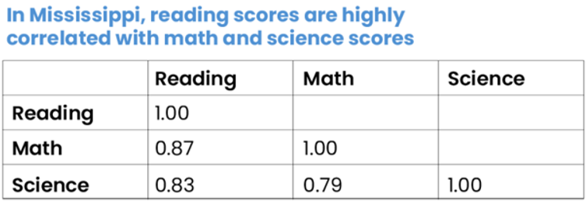
When looking at school-level results, Aldeman reported that he “pulled up the 2025 test scores in the state of Mississippi.” He credited the state with having “some of the best schools in the country,” so he determined “it would be a good test to see whether they specialized or were consistently strong.”
He found that, in Mississippi, “reading scores are highly correlated with math and science scores,” which suggests “schools with high test scores in one content area are very likely to also have high test scores in another subject.”
In order to compensate for the possibility that a school could just happen to enroll more higher— or lower-performing students, he also reviewed growth rates. “In Mississippi, the state measures growth using a model called a value table. Essentially, the state created eight performance levels, and schools receive points if they help students advance to higher tiers from one year to the next.”
Aldeman found that in Mississippi, “schools with high student growth rates tend to see improvement across multiple subject areas.” In other words, schools with high growth in reading scores are also likely to have high growth in math scores. He observed that “it’s fortunately rare to find a school that’s doing a great job in one subject area and letting kids down in another.”
His research further showed that Florida has “a similar accountability system as Mississippi,” and he found similar correlations across subject areas in Florida schools.
In his Reason article, John Stossel wrote that some educators insist on blaming “social things like poverty,” for poor student achievement. They point to “race, class, culture, and identity” as the real culprits, and believe “reading instruction should be left up to teachers.”
But the amazing success of states like Mississippi, one of the poorest states in the country, proves the fallacy of this argument. Citing new teaching aids such as the app, Mentava Reading, which use phonics, Stossel opined that parents in any state can teach their children to read “regardless of the progressive idiocy they may get in school.”
And any child can learn to read quickly and easily using Phyllis Schlafly’s proven phonics programs, Turbo Reader and First Reader, available to parents from Eagle Forum Education & Legal.
Want to be notified of new
Education Reporter content?
Your information will NOT be sold or shared and will ONLY be used to notify you of new content.
Click Here
Return to Home Page