
‘Power Rainbow’ by Harvard grad students teaches 3rd graders about systemic oppression
By James Samuel, Drexel University
Originally posted at The College Fix, December 17, 2025. Reprinted by permission
Two Harvard University graduate students developed a “Power Rainbow” tool to teach elementary schoolers about systemic oppression, including one who was the recipient of a publicly funded scholarship that recently came under Congressional scrutiny.
Anna [Kirby] Deloia, who has since graduated from the Harvard Graduate School of Education, and Hania Mariën, a doctorate student, published the “Power Rainbow” in 2023 to help third- to fifth-grade children “make sense of power and how it shapes our lives and societies,” according to the school’s website.
 The curriculum tool is designed to shift children’s thinking away “from an individual or interpersonal perspective on injustice.” Instead, it teaches them “a more accurate, structural analysis informed by how power operates at different levels of society (e.g., individual unfair actions are influenced by institutions, laws, and cultural norms),” the webpage states.
Deloia was a 2017 recipient of the Truman Scholarship, the subject of a recent Congressional hearing. A series of analyses by The College Fix found that the scholarship is overwhelmingly granted to left-leaning students, and, in some years, no recipients were openly on the right politically.
Overseen by U.S. Congress and funded by taxpayers, the $30,000 scholarship is awarded to around 50 students annually. Awardees promise to spend three of their first seven years after finishing graduate school in public service.
Adam Kissel, a visiting fellow in the Heritage Foundation’s Center for Higher Education Policy, told The College Fix in an email last week that Deloia “appears to be the kind of progressive ‘change agent’ the Truman Foundation privileges in its materials.”
“If the Foundation refuses to remove such biases from the program, Congress should find a better way to honor President Truman’s legacy,” Kissel said.
Frederick Hess, a senior fellow at the American Enterprise Institute who has conducted research on the leftward bias of the Truman Scholarship, echoed these concerns in an email to The Fix. Both he and Kissel testified at the hearing Dec. 3, as well as College Fix Editor-In-Chief, Jennifer Kabbany.
While declining to comment specifically on the Power Rainbow, Hess said, “I continue to have profound concerns that an esteemed, public, taxpayer-funded scholarship program has so little room for conservative views or values and that the program leadership seems determined to ignore the concerns.”
Deloia created the “Power Rainbow” in 2023 after receiving the scholarship, and it continues to be used today. In October, co-creator Mariën taught a workshop about it at the Northwest Teaching for Social Justice Conference in Portland, Oregon.
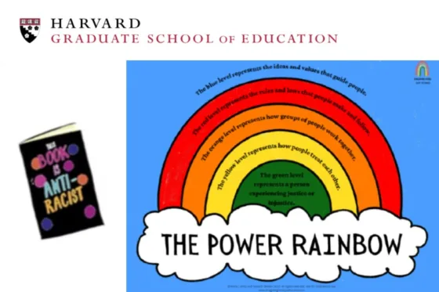 “Grown-ups have created complicated systems of power that can be hard to understand, and equally hard to explain and explore with kids,” according to a description of the workshop.
It says that Mariën used a comic and a “hands-on activity” to teach educators about the Power Rainbow.
The Fix contacted Deloia and Mariën multiple times via email asking for more details about their project, including how many schools have used it, but neither responded.
The summary of the Power Rainbow on Harvard’s website states that it is designed to teach children “the type of structural thinking necessary to research and take action towards more just futures.”
The rainbow contains five levels that, from lowest to highest, represent “a person experiencing justice or injustice,” “how people treat each other,” “how groups of people work together,” “the rules and laws that people make and follow,” and “the ideas and values that guide people.”
Deloia and Mariën also published coloring pages for teachers to use with students.
The co-authors wrote an article detailing the development of their educational tool in the journal Frontiers in Education in 2023. They wrote that “the ability to recognize and analyze systems of power is integral to developing a deep understanding of how injustice is perpetuated, as well as how we can work to dismantle it.”
“Awareness of power often emerges through some form of critical education,” they wrote. “However, it is rarely highlighted in pedagogy or media for children, even within progressive and social justice-oriented spaces.”
In their conclusion, the authors stated that the Power Rainbow “could be brought into classrooms and used as a framework to explore the roles power plays in a variety of different academic subjects.”
Deloia and Mariën wrote that the education tool also is useful “in our adult lives, when we encounter instances of injustice or examples of social activism.”
The two co-run Imagining More Just Futures, “a social justice education project for children and their grown-ups” that promotes the Power Rainbow and “anti-racist” beliefs, according to its website.
The project is a collaboration with Harvard University’s Graduate Commons Program.
The goal is to teach children how to “imagine more socially just futures, and take steps toward creating those futures” by addressing “unfairness.”
As part of the project, Deloia and Mariën also ran a “Critical Participatory Action Research” camp and an “Intergenerational Identity Book Club” that gave families the chance “to engage in conversations about social identity and social justice.” However, neither program appears to be currently running.
Want to be notified of new
Education Reporter content?
Your information will NOT be sold or shared and will ONLY be used to notify you of new content.
Click Here
Return to Home Page