
Something Wicked: Why Feminism Can’t be Fused with Christianity
by Carrie Gress, Ph.D, Sophia Institute Press, 2025
In Something Wicked: Why Feminism Can’t Be Fused with Christianity, Catholic scholar Carrie Gress presents a bold thesis, almost a challenge: feminism can’t be reconciled with Christianity, but is in fact a rival religion.
Gress’s overall approach has four parts:
- Part 1 - Building the New Woman, where she shows that Feminism advocates abandoning Christianity by blaming it for enslaving women.
- Part 2 - The New Faith, which establishes a “shadow church” with a different object of worship, different commandments, virtues, etc.
- Part 3 - Christian Feminism, which describes both Protestant and Catholic Christians who try to infuse their faith with feminism.
- Part 4 - Restoration, she provides a vision of women abandoning the feminist religion.
Gress begins by examining the first wave of feminist leaders. She discusses Matilda Electa Joslyn Gage (1826-1898), who “embodied first-wave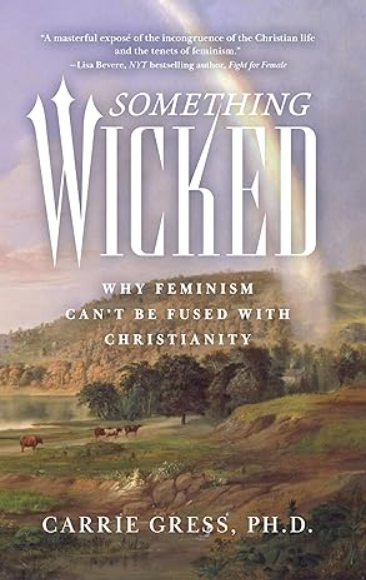 feminism leadership in her rejection of Christianity, her questionable use of outrageous tactics, and her relentless fixation on womanhood apart from what feminists considered the enslavement of family.”
The author explains that Gage worked alongside first-wave feminists Elizabeth Cady Stanton and Susan B. Anthony, but “broke ranks with Stanton and Anthony, who joined forces with the Women’s Temperance Movement, a move Gage found disagreeable because of the group’s opening Christian principles.” Gress views Stanton’s and Anthony’s decision as “pragmatic.”
“Like most of her first-wave comrades, Gage was involved in various occult activities, including theosophy, seances, manifesting, and a firm belief in good and bad witchcraft.” Gress sees Gage’s influence in The Wonderful Wizard of Oz, written by Gage’s son-in-law L. Frank Baum — a mystical land ruled by good and bad witches, with a patriarchal bully who needed to be exposed.
Gress then delves back even further into history, to Mary Wollstonecraft (1759 — 1797), often considered the first feminist. Wollstonecraft embodied the ideals of the French Revolution, returning to England with “broken heart and fatherless child.”
The author tells the story of Wollstonecraft and her fatherless child — Mary Godwin Shelly, who wrote the book Frankenstein, published in 1818. Christians have interpreted the story of Frankenstein as a reminder of what happens when people disobey God and take issues of life into their own hands. The impact of this book should not be underestimated. Since the mid-1800s it has never been out of print.
Gress acknowledges that these first-wave feminists were not representative of women of the era. She recounts the example of Hannah More (1745 — 1833), a “prolific author, educator, Bluestocking, and public celebrity of her day,” who — as an Evangelical Christian — “promoted literacy among the poor through the new English system of Sunday School programs.”
But she then goes down the list of first-wave feminists who abandoned Christianity in favor of Unitarianism, spiritualism, or the occult. She summarizes first-wave feminism as making men the enemy, labeling them as enslavers, advocating for a secular vision of womanhood, and abandoning a Christian or theological path for healing humanity.
Gress’s story then moves into the 20th century, where the vision of the “New Woman” was a woman “released from the shackles of male and Christian oppression and traditional morality, so she too could engage in sex without procreation and compete publicly with men.”
The author describes how “Betty Friedan and her book, The Feminine Mystique, ushered in feminism’s second wave.” Second-wave feminism, Gress writes, “promoted free love, abortion activism, further elimination of the patriarchy, and engagement with the occult.”
As labor-saving devices made housekeeping easier, women “poured themselves into advertising and magazines,” leading to the “caricature of a shallow 1950s purposeless woman.... Friedan was able to hit this nerve with The Feminine Mystique,” which sold more than 3 million copies.
Gress’s book is filled with gems such as:
- Unexamined models, such as “abortion as health care, Christianity as confining, sexual license as a basic freedom and right, and my body, my choice.”
- “Autonomy is central to the feminist vision.”
- “The way to heal and restore ... restoring worship, reverence, and obedience to its proper place: to God. Until this right relationship between God and woman is restored, women will continue to thrash around, restless, looking for something new to fill the void left in their hearts ... the answer to the problem they have tried to solve for over two hundred years is found in the very thing they sought to eliminate in the first place: Christianity.”
- “Women have been living for a long time with the Romantic Lie that the model of womanhood followed today is chosen in freedom.”
- “... an aping of man, associated with an unceasing undertone of envy and resentment.”
- “The blame only goes one way — to men — because women, as we have been told, can never be wrong.”
- “Feminism, insofar as it suggests the eradication of the patriarchy, is following the way of Eve. The serpent supplants the role of God; Eve supplants Adam; Adam becomes submissive. God is somehow missed or forgotten.”
- “... when men’s gifts are accepted and appreciated, suddenly the whole picture looks different.... These are the essentials for the return of romance.”
- “A real truce can only come through the realization that men and women need each other.”
Gress’s assertion that feminism is not compatible with Christianity is indeed bold. Just to examine this claim is reason enough to read the book, along with the importance, relevance, and timeliness of the topic.
To read the entire book, go to Amazon.com to order!
Want to be notified of new
Education Reporter content?
Your information will NOT be sold or shared and will ONLY be used to notify you of new content.
Click Here
Return to Home Page