
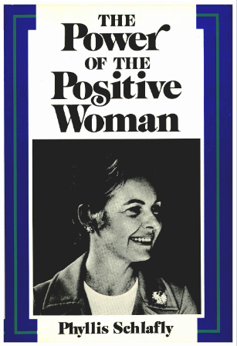
The Power of the Positive Woman
By Phyllis Schlafly, Arlington House Publishers, 1977
Editor’s Note: This book is out of print, but Education Reporter will email you a complimentary copy in easy to download PDF format that you can read on your favorite device. To get your free copy, just click this link and fill out the brief form.
At the very beginning of her wonderful book, The Power of the Positive Woman, Phyllis Schlafly said it all when she wrote: “To the Positive Woman, her particular set of problems is not a conspiracy against her, but a challenge to her character and her capabilities.”
 Phyllis compares this “positive” attitude with that of the feminists at the time she wrote her book, and the shoe fits even today, as most feminists still wallow in self-pity, believing that being born female is a handicap. Phyllis described the feminist attitude with tongue-in-cheek:
- This is the self-articulated dog-in-the-manger chip-on-the-shoulder fundamental dogma of the women’s liberation movement. Someone — it is not clear who, perhaps God, perhaps the “Establishment,” perhaps a conspiracy of male chauvinist pigs—dealt women a foul blow by making them female. It becomes necessary, therefore, for women to agitate and demonstrate and hurl demands on society in order to wrest from an oppressive, male-dominated social structure the status that has been wrongfully denied to women through the centuries.
Phyllis deduced that probably what feminists were most upset about was the fact that they have babies and men do not. Of course, in the twisted world of today, the woke among us may dispute that biological fact. But when Phyllis wrote The Power of the Positive Woman, it was just that, an accepted biological fact, albeit one that had to be changed by promoting contraception, legalizing abortion, and establishing child care centers for all women and all children, regardless of income, religion, or any other factor. And child care was to be paid for by government; i.e. taxpayers.
In her inimitable way, Phyllis’s book provides logic, sensibility, and a kind of calm that only truth can inspire. She wrote: “it is self-evident to the Positive Woman that the female body with its baby-producing organs was not designed by a conspiracy of men but by the Divine Architect of the human race. Those who think it is unfair that women have babies whereas men cannot will have to take up their complaint with God, because no other power is capable of changing that fundamental fact.”
Like many women of the time who supported her, Schlafly celebrated femaleness and fertility as part of woman’s “unique purpose, potential, and power.” Phyllis put into simple yet absorbing language the unchangeable biological facts that differentiate men and women, such as in sports and other avenues where physical size and strength render women at a physical disadvantage.
She further makes her case by explaining that women’s roles as mothers, nurturers, and moral anchors are not outdated burdens but meaningful contributions that shape communities. Her argument that legal and cultural protections for women should be preserved rather than erased in the name of uniformity, is presented as both practical and compassionate.
Schlafly points out that the “Divine Architect who gave men superior strength to lift weights also gave women a different kind of superior strength,” and she explains why pushing the sexual revolution in the 1970s was “such a cheat on women.”
She contends:
- The Positive Woman recognizes the fact that when it comes to sex women are simply not the equal of men.... The other side of the coin is that it is easier for women to control their sexual appetites. The Positive Woman cannot defeat man in a wrestling or boxing match but she can motivate him, inspire him, encourage him, teach him, restrain him, reward him, and have power over him that he can never achieve over her with all his muscle.
In reading Phyllis’s truths that were undeniable nearly 50 years ago and remain undeniable today, such as when she describes the “maternal need” among females, one can imagine the rage her words might engender in the completely illogical and often unhinged psyches of today’s feminists. They have been lied to for so long and so outrageously, it’s no wonder they reject the immutable traits and differences that are not in sync with the brainwashing they have received throughout their youth via the schools and the culture.
One tidbit this reviewer did not recall and found surprising is the fact that feminists of the 1970s were asserting there are no differences between men and woman and that separate school activities for boys and girls, such as “mother-daughter breakfasts” or “father-son” banquets, should be prohibited. They were already fostering the notion that boys and girls should not be subject to “separate treatment.” Some may recognize it as the prerequisite to such outrages as girls invading boys’ locker rooms and vice versa today.
But Phyllis was, as usual, way ahead of her time when she wrote: “It is no gain for women, for children, for families, or for America to propel us into a unisex society. Our strength is in our diversity, not in our sameness.” She was not only referring to the sexes, but to the races as well.
Throughout the book, Phyllis relays many entertaining and inspiring examples of strong, successful, and often well-known women who “made it” in a world where feminists were lamenting that the deck was stacked against them. She correctly noted that “the Positive Woman spends her time, ingenuity, and efforts seizing her opportunities—not whining about past injustices.” She makes the case that American women have been liberated by “the free enterprise system,” which inspired inventors to develop ever better labor-saving devices, and “by the increased receptivity toward women in business and the professions.”
Phyllis wrote The Power of the Positive Woman at a time in our nation’s history when the culture was shifting rapidly; when the unique distinctions that naturally set men and women apart were beginning to blur. She argues that women’s strengths—biological, emotional, and social — are not limitations but sources of power, and that accepting and embracing these differences lead to a more fulfilling life for women, their families, and society as a whole.
This reviewer found the book to be a welcome and reassuring alternative, not only to the relentless drumbeat of 1970s feminism, but to the craziness of the society we live in today as well. Readers will find that The Power of the Positive Woman remains even more relevant now because it describes a meaningful worldview that still makes sense for all human beings. They will recognize that differences between the sexes deserve to be celebrated rather than erased.
Phyllis Schlafly’s timeless work gives a voice to women who still see value and empowerment in accepting rather than rejecting traditional roles.
Want to be notified of new
Education Reporter content?
Your information will NOT be sold or shared and will ONLY be used to notify you of new content.
Click Here
Return to Home Page